Your business is performing well, your order pipeline is full, and revenue is growing. Yet on the last day of the month, there's barely anything left in your account. How is that possible?
This is one of the most common financial pitfalls for SMEs: profitable on paper, but tight on liquidity. The cause? Profit and cashflow are not the same thing. And whoever doesn't keep a close eye on that difference will eventually hit a wall.
In this article, you'll learn how to calculate your company's cashflow, including the formula, the methods, and a concrete worked example. Ready to move from calculating to managing afterward? Then also read our comprehensive guide: Cashflow Management for Business Owners.
What exactly is cashflow?
Cashflow is the difference between the money coming into your business in a period and the money going out. Put simply: what actually appears in your bank account, not what you've earned on paper.
There are three types of cashflow:
Operating cashflow: cash flows from your day-to-day business activities (revenue, salaries, rent, suppliers).
Investment cashflow: cash flows from buying or selling assets (machinery, inventory, real estate).
Financing cashflow: cash flows from loans, repayments, or shareholder capital.
The total cashflow is the sum of these three. For day-to-day management, operating cashflow is most relevant.
The cashflow formula
A simple way to calculate cashflow is the indirect method: you start with net profit and adjust for items that appear in your profit but don't represent actual cash movement. This method is not the most accurate and gives you more of a general picture.
Cashflow = Net Profit + Depreciation +/- Changes in Working Capital
The key working capital items:
Debtors (increase = less cash)
Creditors (increase = more cash)
Inventory (increase = less cash)
In addition to the indirect method, there's also the direct method: here you add up all actual cash receipts and subtract all actual cash disbursements. This gives you a more accurate picture of your actual liquidity position.
Liquid calculates cashflow automatically for you
Liquid connects directly to your accounting software (such as Exact Online, Twinfield, or AFAS) and calculates your operating cashflow automatically using the direct method. No manual adding, no spreadsheet formulas. Your actuals are always up-to-date in your dashboard, per day, week, or month.
Direct vs. indirect method: what's the difference?
Direct method | Indirect method | |
|---|---|---|
Starting point | Actual cash flows (bank transactions) | Net profit from the P&L statement |
Accuracy | High (based on actual payments) | Low (adjustments to accounting profit) |
Suitable for | Liquidity planning, day-to-day management | General insight |
Time investment manually | High | High |
Time investment with Liquid | Automatic | - |
Worked example: calculating cashflow step by step
Suppose you run a manufacturing business with the following figures for May:
Net profit: €15,000
Depreciation: €3,000
Debtors increased by: €8,000 (customers haven't paid yet)
Creditors increased by: €2,500 (you haven't paid suppliers yet)
Inventory decreased by: €1,000 (inventory converted to revenue)
Calculation (indirect method):
Net profit:              + €15,000
Depreciation:            + €3,000
Increase in debtors:     - €8,000
Increase in creditors:   + €2,500
Decrease in inventory:   + €1,000
                        ----------
Operating cashflow:      = €13,500
Despite a profit of €15,000, the actual cash inflow is €13,500, because part of the revenue hasn't been collected yet. Does this pattern sound familiar? Then you know why cashflow and profit are two fundamentally different things.
Common mistakes when calculating cashflow
Confusing profit and cashflow. Recording an invoice is not the same as receiving money.
Forgetting seasonal peaks. One strong month can mask a weak month later if you don't look at each period.
Ignoring VAT. You collect VAT on behalf of the tax authority. That money isn't yours. Don't count it as available cash.
Not accounting for different payment terms. One customer pays within 14 days, another not until 60 days. Your supplier wants payment within 30 days, but another expects 45 days. All these terms run together and determine how much cash sits in your account on any given day. Tracking manually is impossible: you have dozens of outstanding invoices, each with their own due date. One forgotten invoice or a customer paying a week later than expected, and your forecast is off.
Calculating once instead of monitoring continuously. A calculation from last month tells you little about next week.
Always your latest figures, without manual work
In Liquid you see your cashflow actuals in real-time. No manual exports, no outdated Excel files. You always know exactly where you stand.
From calculation to forecast: looking ahead with cashflow
Calculating cashflow gives you insight into the past. But for real financial control you look forward: what do you expect to receive and spend over the next four, eight or twelve weeks?
That's where a cashflow forecast comes in. You estimate future inflows and outflows based on:
Outstanding receivables and expected payment terms
Planned purchase invoices and fixed costs
Expected revenue based on pipeline or order book
Seasonal patterns from historical data
The challenge? You have dozens of outstanding invoices at any moment (from customers paying at 14, 30 or 60 days, and suppliers with their own terms). Want to know what you'll have in your account in three weeks? You need to map all those expected payments across a timeline. In a spreadsheet that's a day's work. And tomorrow everything changes again.
Thankfully, building a forecast in Liquid doesn't happen in isolation. What do we mean: while you used to create separate forecasts for profit and loss, liquidity and balance sheet, in Liquid it's all automatically connected. Our engine calculates everything through, so you can focus entirely on strategy.
Forecasts that update themselves: including all payment terms
Liquid pulls your outstanding receivables and payables directly from your accounting package and automatically calculates based on expected payment dates what will flow in and out of your account over the coming weeks and months. All terms, intertwined (Liquid solves it). You just need to steer.
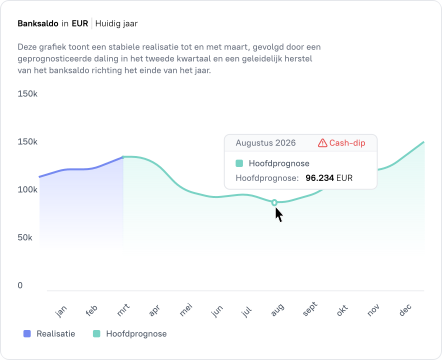
On top of your actuals you build rolling forecasts: set your assumptions for expected revenue and fixed costs, and test scenarios risk-free. What if a major customer pays two weeks late? What if next month's revenue drops 20%? You see the impact immediately on your future liquidity position.
Conclusion
Calculating cashflow is the first step toward financial control. With the right formula and a good understanding of your working capital you know exactly how much cash your business generates (separate from what the books say about profit).
But calculating once isn't enough. If you truly want to be in control, you monitor your actuals continuously and look ahead with a reliable forecast (without losing hours manually tracking payment terms).
Want to know how to take your cashflow management to the next level? Read: Cashflow Management: A Comprehensive Guide for Business Owners →
Or discover how Liquid automatically tracks and forecasts your cashflow: View the solution →