Intro
Your accountant asks for it. The bank wants to see it when you apply for a loan. And if you want control over your liquidity, there's no way around it: the cash flow statement.
Yet many entrepreneurs and finance professionals don't know exactly what belongs in it, how to prepare it, and what the difference is between the direct and indirect method. In this article, we'll explain it step by step: what a cash flow statement is, which three sections it contains, how to read it, and how to generate it in practice without spending hours on it.
What is a cash flow statement?
A cash flow statement (also called: cashflow report or cash flow overview) is a financial statement that shows how much money flows in and out of your business over a specific period. The statement is separate from profit or loss: while a profit and loss statement works on the basis of accrued revenues and expenses, the cash flow statement shows only actual cash flows.
That makes it one of the three core documents in financial statements, alongside the balance sheet and the income statement. But it's also a crucial operational management tool: the cash flow statement tells you whether your business currently has sufficient liquidity to meet its obligations.
In short: profit is an opinion, cash is a fact. The cash flow statement reports the facts.
The three sections of a cash flow statement
Every cash flow statement consists of three fixed components. Together, they give you a complete picture of where the money comes from and where it goes.
Section | What it contains | Positive signal | Point of attention |
|---|---|---|---|
1. Operating cash flow | Cash flows from daily business activities: customer receipts, payments to suppliers, salaries, rent, taxes | Business generates cash from its core operations | Business needs more cash than it generates |
2. Investing cash flow | Cash flows from purchase or sale of assets: machinery, inventory, investments, software | Sale of assets generates cash | Large investments put pressure on liquidity (sometimes intentional and healthy) |
3. Financing cash flow | Cash flows from financing activities: taking on or repaying loans, dividend payments, share issuance | New capital raised | High repayment obligations put pressure on free cash |
The net cash flow is the sum of all three. A positive final result means you received more cash than went out. A negative final result is not necessarily bad: if operating cash flow is strongly positive but you've invested heavily, the total can temporarily be negative while the business is financially healthy.
Understanding why the total is positive or negative is the key to reading a cash flow statement.
Direct vs. indirect method: what's the difference?
There are two ways to prepare the operating cash flow. The choice determines how the statement looks, but the final figure is the same.
The direct method
With the direct method, you add up all actual cash receipts and subtract all actual cash expenses. You start from your bank account: what actually came in, what actually went out?
This gives the most accurate picture of your liquidity position on a daily basis. The downside: if you do this manually, you have to categorize every transaction. That's time-consuming.
The indirect method
With the indirect method, you start with net profit from the income statement and adjust for items that are not actual cash movements: depreciation, changes in receivables, payables, and inventory. This is easier to prepare from your accounting records and is therefore most commonly used in financial statements.
The downside: you can't directly see when money comes in or goes out. For short-term liquidity planning, this is less suitable.
Direct method | Indirect method | |
|---|---|---|
Starting point | Actual cash flows (bank transactions) | Net income from the P&L statement |
Accuracy | High | Lower (adjustments to accounting profit) |
Best for | Liquidity planning, day-to-day management | Annual financial statements, high-level insight |
Manual time investment | High | High |
With Liquid | Automatic | Not needed |
Liquid generates your cash flow statement automatically
Liquid connects directly to your accounting software and builds your cash flow statement automatically using the direct method. No manual categorization, no Excel formulas, no outdated exports.
Your actuals are always up-to-date. You see exactly what flowed in and out day by day, week by week, or month by month—broken down by the three cash flow categories. And you can click straight through from the overview to the underlying invoices.
How to create a cash flow statement? (step by step)
Whether you use the direct or indirect method, the setup process always follows the same logic.
Step 1: Define the period
A cash flow statement always covers a fixed period: a month, a quarter, or a financial year. For operational management, monthly is preferred. For annual financial statements, the financial year is the standard.
Step 2: Gather your source data
You need: bank statements (for the direct method) or the P&L statement plus opening and closing balance sheets (for the indirect method). In practice, you pull this from your accounting software.
Step 3: Categorize into the three sections
Classify each transaction as operating, investing, or financing. This is the step that takes the most manual effort if you're not using an automated tool.
Step 4: Calculate net cash flow per section
Add up inflows per section, subtract outflows. Then add all three sections together for total net cash flow.
Step 5: Reconcile with your opening balance
Opening balance + net cash flow = closing balance. This final figure must match your cash balance on the balance sheet at period end. If it doesn't, there's an error in your categorization.
From accounting data to boardroom-ready report in just a few clicks
Liquid handles steps 2 through 5 completely automatically. Once your accounting software is connected, Liquid pulls in the transactions, categorizes them, and prepares them in a structured cash flow statement. No manual consolidation, no balance sheet reconciliation. Everything reconciles automatically.
The result: a clean, boardroom-ready cash flow report that you share as a live dashboard or export as a PDF. Your finance team saves hours every month. You always see the current state of affairs.
Cash flow statement example: how to read it?
Below is a simplified example of a cash flow statement for a quarter for an SME (indirect method):
Item | Amount |
|---|---|
OPERATING CASH FLOW | |
Net income | +42.000 |
Depreciation | +5.000 |
Increase in accounts receivable | -18.000 |
Increase in accounts payable | +7.500 |
Decrease in inventory | +3.000 |
Net operating cash flow | = 39.500 |
INVESTING CASH FLOW | |
Machine purchase | -25.000 |
Net investing cash flow | = -25.000 |
FINANCING CASH FLOW | |
Bank loan repayment | -8.000 |
Net financing cash flow | = -8.000 |
NET CASH FLOW | = 6.500 |
Opening cash balance | 14.200 |
Closing cash balance | 20.700 |
How do you read this? The business is operationally healthy: it generates 39.500 euros in cash from its core activities. It invested in a machine (a deliberate expenditure), paid down a loan, and closed the quarter with 6.500 euros more cash than it started with.
One thing to watch: accounts receivable increased significantly, which means customers are paying later than expected. That's exactly the signal a cash flow statement reveals, but an income statement doesn't.
Common mistakes when preparing a cash flow statement
Counting VAT as your own revenue. Collected VAT is pass-through money: it belongs to the tax authority. If you count it as available cash, you overstate your liquidity position.
Forgetting depreciation in the indirect method. Depreciation is an accounting expense but not a cash outflow. It must be added back to net income.
Putting investments in the wrong place. A machine is not an operating expense—it belongs in investing cash flow. If it's categorized incorrectly, your operating cash flow gives a distorted picture.
Creating a static report instead of a living document. A report from last month is useful for financial statements, but for management control you need a report that updates as your accounting updates.
Failing to reconcile the report with the balance sheet. The closing balance must always match the cash balance on your balance sheet. If there's a difference, there's an error in the categorization.
Liquid eliminates these errors by design
Because Liquid works directly from your accounting software, categorization, VAT correction, and balance sheet reconciliation are already built in. You don't need to manually check whether the closing balance is correct: Liquid does it for you.
No errors from miscategorization. No forgotten adjustments. No report that's already outdated the moment you share it. Always accurate, always current.
From cash flow statement to cash flow forecast
A cash flow statement looks back. But if you want to stay in control, you look ahead: how much cash do you expect to have over the next four, eight, or twelve weeks?
That's where you need a cash flow forecast. You build it by combining your actual results with:
Outstanding receivables and expected payment dates
Planned purchase invoices and fixed costs
Expected revenue based on pipeline or order book
Scenarios: what if a major customer pays two weeks late? What if revenue drops 15%?
The connection between the historical cash flow statement and the forward-looking forecast is exactly where most Excel models break down. Your forecast always lags behind reality unless you manually update it after every accounting entry.
Want to know more about cash flow forecasting? Read: How to calculate cash flow.
Actual results and forecast in the same screen
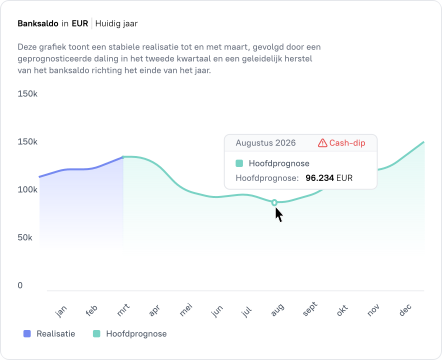
Liquid combines your cash flow statement (actual results) and your cash flow forecast in an integrated platform. Because your accounting system is live-connected, your forecast updates automatically.
On top of your actual results, you build rolling forecasts: set your assumptions, connect drivers (such as expected revenue growth or payment terms) and test scenarios without risk. What's your runway if revenue drops for two months? You see it instantly.
And all of this without separate spreadsheets for your P&L, balance sheet and liquidity. The Liquid Engine connects them automatically. You just need to steer.
Cash flow statement vs. P&L: what's the difference?
Both documents are about money, but they tell different stories.
Cash Flow Statement | P&L | |
|---|---|---|
What does it measure? | Actual cash flows (cash in/out) | Accrued revenue and expenses |
Invoice sent, not yet paid | Doesn't count (no cash yet) | Does count (revenue already booked) |
Equipment depreciation | Doesn't count (no cash outlay) | Counts as an expense |
Ideal for | Liquidity management, solvency check | Profitability analysis, performance |
Period-based? | Yes | Yes |
A company can be profitable on the P&L and still have cash flow problems, simply because customers pay late or because there's been heavy investment. Conversely, a company can run a temporary loss but still have plenty of cash on hand. You need both documents for a complete picture.
Frequently asked questions about the cash flow statement
What's the difference between a cash flow statement and a cashflow report? None. They're two names for the same document. "Cash flow statement" is the standard English term, while "cashflow report" or "cashflow overview" are variations commonly used in practice.
Is a cash flow statement mandatory? For medium-sized and large companies (under accounting regulations), the cash flow statement is a mandatory part of the financial statements. Small companies aren't formally required to produce one, but a bank or investor can always ask for it. And for your own steering, it's essential anyway.
What's the difference between the direct and indirect method? With the direct method, you start with actual bank movements. With the indirect method, you start with net profit and adjust for non-cash receipts and payments. The final operating cash flow figure is the same with both methods. The direct method provides better insight into the payment behavior of customers and suppliers.
How often should you prepare a cash flow statement? For financial statements: annually. For operational steering: at minimum monthly, preferably weekly or real-time via a connected platform.
Can I create a cash flow statement in Excel? Yes. You need a template with the three sections, fill in the data manually from your accounting records and verify that the ending balance matches your balance sheet. The downside: it's time-consuming, error-prone and the statement becomes outdated as soon as you create it. Platforms like Liquid generate it automatically and keep it real-time current.
What does negative cash flow mean? That more money went out than came in during that period. That's not necessarily bad: if the negative cash flow is caused by a large investment while operating cash flow is positive, the company can still be in good health. Always look at the three sections separately.
Conclusion
A cash flow statement is not an afterthought. It's the document that shows whether your company is truly financially healthy, regardless of what the P&L says. It tells you when money comes in, when it goes out and whether you have enough liquidity to meet your obligations.
You prepare it using either the direct or indirect method, in three sections: operating, investing and financing. Net cash flow ties back to your balance sheet. And for real steering, you link it back to a forecast.
Doing it manually? Expect hours of work each month, errors from miscategorization, and an overview that's outdated the moment you share it. Or choose Liquid: connect your accounting package, and your cash flow statement is automatically ready. Current, accurate, and boardroom-ready.
Discover how Liquid automates your cash flow statement
Read more: